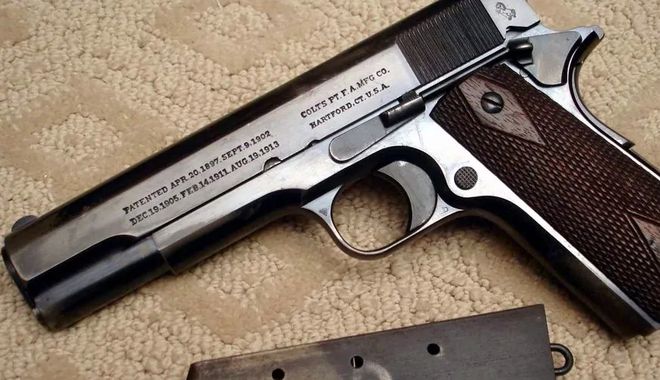
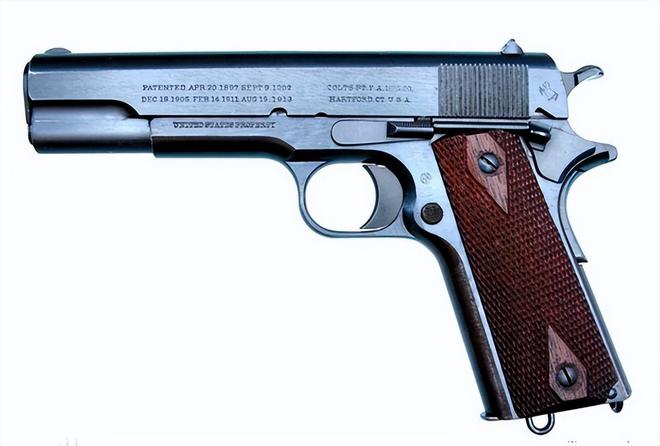
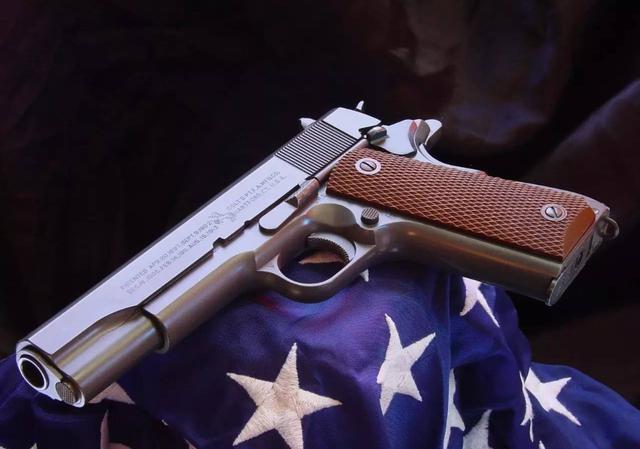
The Colt M1911 and its improved variant, the M1911A1, stand among the most iconic semi-automatic pistols in firearms history. Adopted by the U.S. military in 1911, this .45 ACP-caliber handgun earned global acclaim for its reliability, stopping power, and minimalist design. Despite advancements in modern firearm technology, the M1911 series remains in service with special forces, competitive shooters, and collectors, spanning two World Wars, the Korean War, Vietnam, and beyond—a true “century-long classic.”
Origins and Design Philosophy In the early 20th century, the U.S. military identified the inadequate stopping power of .38-caliber revolvers during the Philippine-American War, prompting the need for a more potent sidearm. Famed designer John Browning responded with the M1911, chambered in .45 ACP (Automatic Colt Pistol). This cartridge (230-grain bullet, ~250 m/s muzzle velocity) delivered decisive knockdown power, while Browning’s short-recoil operation and 7-round single-stack magazine balanced firepower and portability.
Technical Features and Performance
Ergonomics: Its natural grip angle and crisp single-action trigger aided accuracy. The 1924 M1911A1 upgrade refined the grip safety, hammer, and sights.
Simplicity and Durability: The M1911’s tilting-barrel locking mechanism and minimal parts ensured reliability even in muddy or sandy conditions.
.45 ACP Dominance: The round’s high stopping power made it ideal for close-quarters combat, though its recoil required skilled handling.
Service History and Combat Legacy The M1911 series proved its mettle in both World Wars. WWII soldiers praised its “one-shot-stop” capability, while Vietnam-era Special Forces often carried M1911A1s as backups. Even after being replaced by the Beretta M9 in 1985, units like Delta Force retained customized M1911s for their unmatched reliability.
Cultural Impact and Modern Evolution The M1911’s design inspired countless derivatives (e.g., Springfield Armory’s “Operator” or Colt’s “Gold Cup”). Civilian markets embraced it for competition and collecting, and Hollywood (e.g., The Terminator, The Matrix) cemented its “tough-guy” image. Today, modular upgrades (e.g., tactical rails, fiber-optic sights) keep this classic relevant.
Conclusion
The Colt M1911/M1911A1 transcends being merely a weapon—it embodies the fusion of engineering elegance and battlefield pragmatism. Its century-long legacy validates Browning’s vision: true classics endure not through constant change, but by staying faithful to their essence.