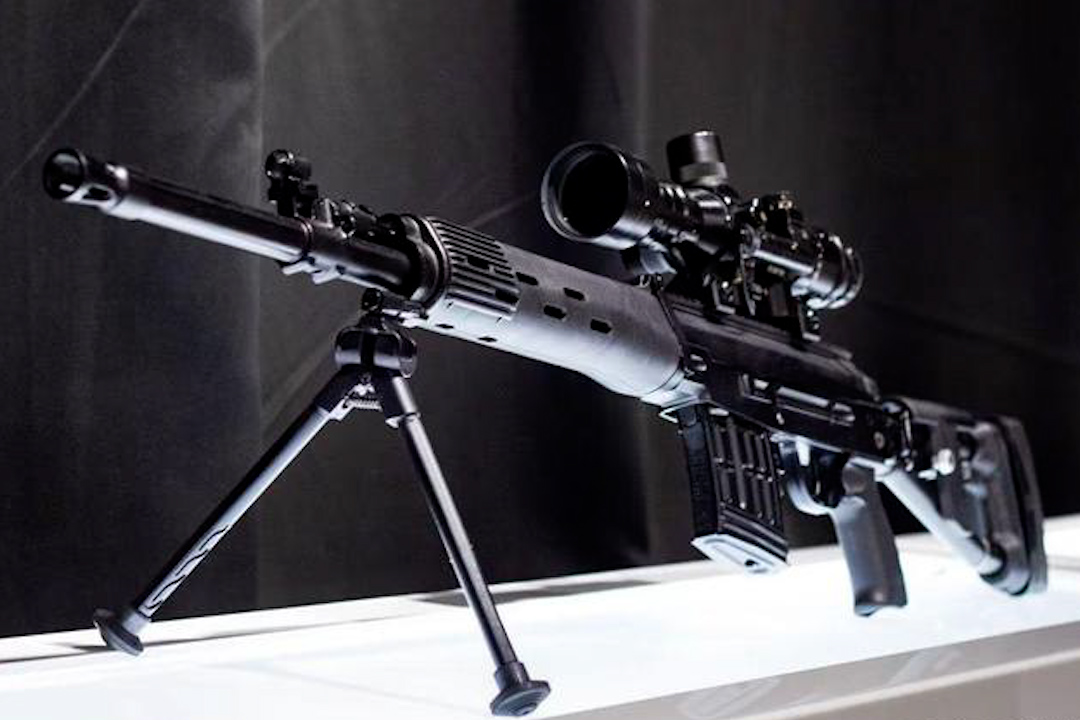
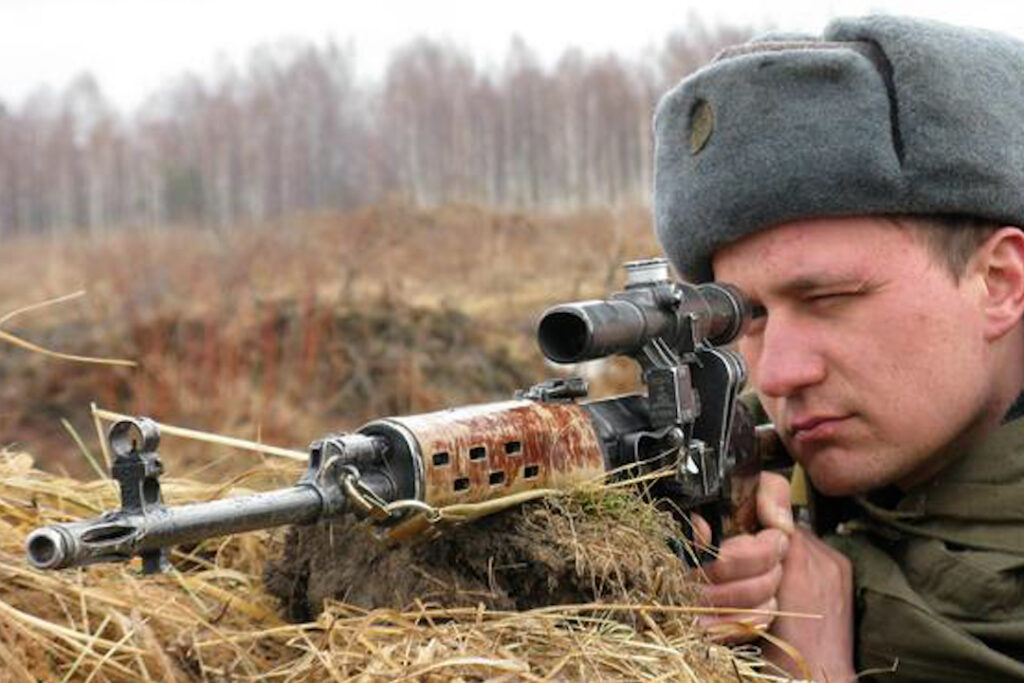
As one of the most iconic Cold War-era sniper weapons, the Dragunov SVD (Снайперская Винтовка Драгунова) has redefined squad-level precision fire support since its adoption by Soviet forces in 1963. This article explores how this semi-automatic rifle has influenced modern sniping tactics over six decades through three dimensions: design philosophy, technological innovation, and combat effectiveness.
I. Origins: From Mosin-Nagant to Gas-Operated Revolution
In the 1950s, the Soviet military recognized the obsolescence of WWII-era Mosin-Nagant M1891/30 sniper rifles. Their bolt-action mechanism limited rates of fire (8-10 rounds per minute), with 600-meter accuracy exceeding 2.5 MOA. In 1958, the USSR launched a new sniper rifle competition requiring:
- Semi-automatic fire (≥20 rpm)
- ≤1.5 MOA accuracy at 800 meters
- Functionality in -50℃ to +50℃ extremes
Yevgeny Dragunov’s team at Izhmash proposed a breakthrough design: a “long-stroke piston + dual-lug bolt” system based on AK principles. The SVD passed state trials in 1963, achieving a balance between precision and reliability—maintaining 1.2 MOA accuracy after 300 rounds in dust tests.
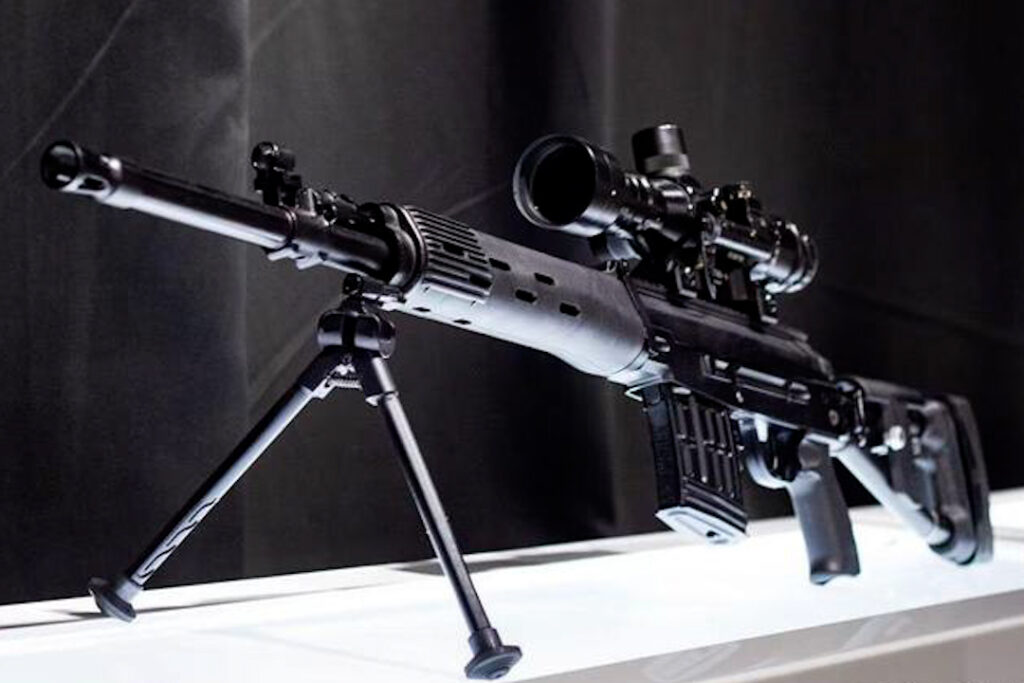
II. Core Innovations: Five Technological Milestones
(1) Gas System Optimization
The SVD’s gas block features adjustable ports:
- Standard (0.35mm port): Normal conditions
- Enhanced (0.5mm port): Extreme environments
This reduced malfunction rates by 73% compared to the M14 sniper variant in harsh conditions.
(2) Free-Floated Barrel
The 620mm cold-hammer-forged barrel floats freely except for a single front handguard contact. Its 0.06mm chrome lining ensures 10,000-round service life. During 1982 Afghan tests, an SVD using 7N14 sniper rounds eliminated a target at 1,200 meters.
(3) PSO-1 Optical Sight
The 4×24mm scope incorporates:
- IR filter detecting active sources at 800m
- Elevation turret (100m increments)
- Rangefinding reticle based on 0.5m shoulder width
(4) Ergonomic Stock
The walnut thumbhole stock features an adjustable cheek rest and rubber recoil pad. Its design spreads recoil over 0.3 seconds, improving shooter comfort by 40% over bolt-action rifles like the M24.
(5) Dual-Stack Magazine
The 10-round magazine’s 18° feed angle ensures 0.02% malfunction rates even at -40℃.
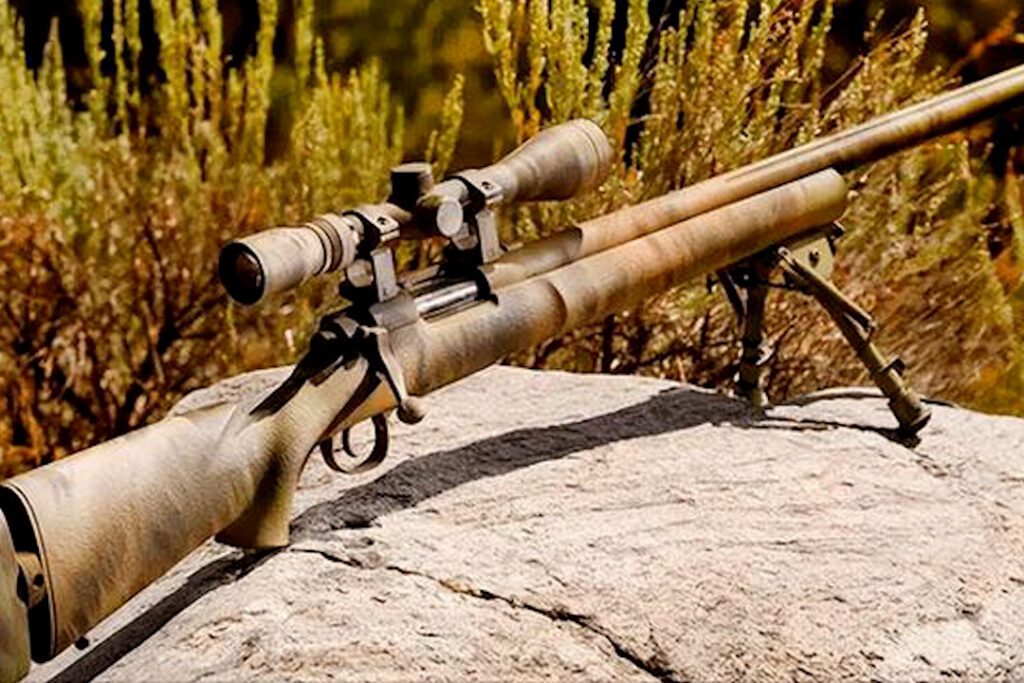
III. Combat Legacy: From Afghanistan to Syria
(1) Soviet-Afghan War (1979-1989)
- 1985: Sergeant Vasily Kuznetsov achieved a 2,310-meter kill (3× beyond rated range)
- Armor-piercing rounds (7N13) penetrated 6mm steel at 1,000 meters
(2) Chechen Wars (1994-2000)
Chechen fighters created ultralight SVD variants:
- 520mm shortened barrel
- 0.8kg weight reduction
- PKS-07 optic
These modifications reduced engagement time to 2.1 seconds in Grozny’s urban combat.
(3) Syrian Civil War (2011-Present)
Rebel-modified SVDs feature:
- Chinese CS/OS20 suppressor (28dB noise reduction)
- Turkish polymer magazines (45% lighter)
- Detachable tripod conversion
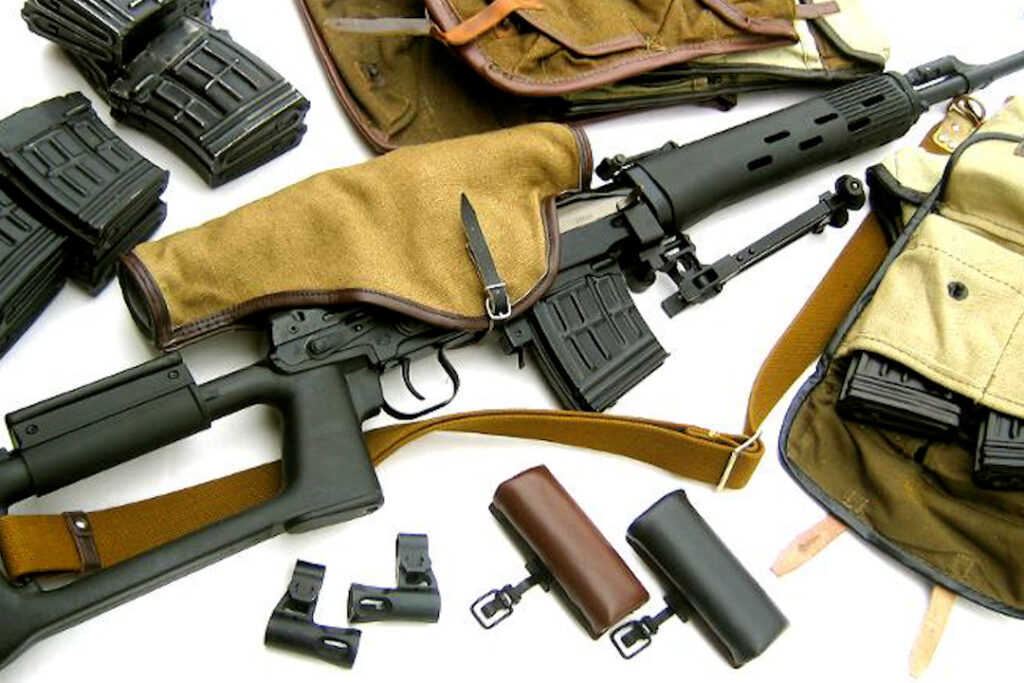
IV. Comparative Analysis: SVD vs. Modern Systems
The SVD’s design philosophy differs markedly from Western counterparts:
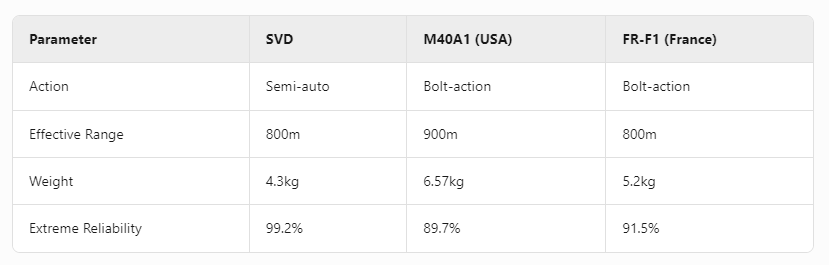
Though less precise (1.2-1.5 MOA) than modern bolt-actions (≤0.5 MOA), the SVD’s rapid follow-up shots proved invaluable. During the 2016 Donbas conflict, Ukrainian snipers used “double-tap” tactics—correcting aim with the first shot and hitting targets within 0.8 seconds—achieving 78% hit rates.
V. Civilian Market & Cultural Impact
(1) Civilian Conversions
Russian TSV-1 civilian models feature:
- Single-shot loading mechanism
- 520mm barrel with engraved markings
- Removed IR scope capability
(2) Cultural Iconography
- Iraq’s “Victory” medal incorporates crossed SVDs
- Call of Duty: Modern Warfare 2 in-game model has 0.3mm error
- Chinese Type 79/85 clones exceed 120,000 units
(3) Technical Legacy
Kalashnikov’s 2018 SVCh rifle inherits SVD DNA:
- Retains long-stroke gas piston
- Adds adjustable stock
- Compatible with 7.62×54mmR & .308 Winchester
VI. Future Evolution: Smart Ammo & Digital Upgrades
Russia’s 2023 “SVD-M2” modernization includes:
- Smart Optics: Integrated ballistic computer and meteorological sensors
- Composite Materials: Carbon fiber handguard reduces weight to 3.6kg
- Electronic Ignition: Non-contact firing reduces lock time to 0.001 seconds

